How to cast on (knitting)
Casting on is how you put the first stitches on your needle. Learn the easiest beginner method step by step, plus when to use long-tail, cable and stretchy cast ons.
 By Julia WallinKnyt Co-founder and editor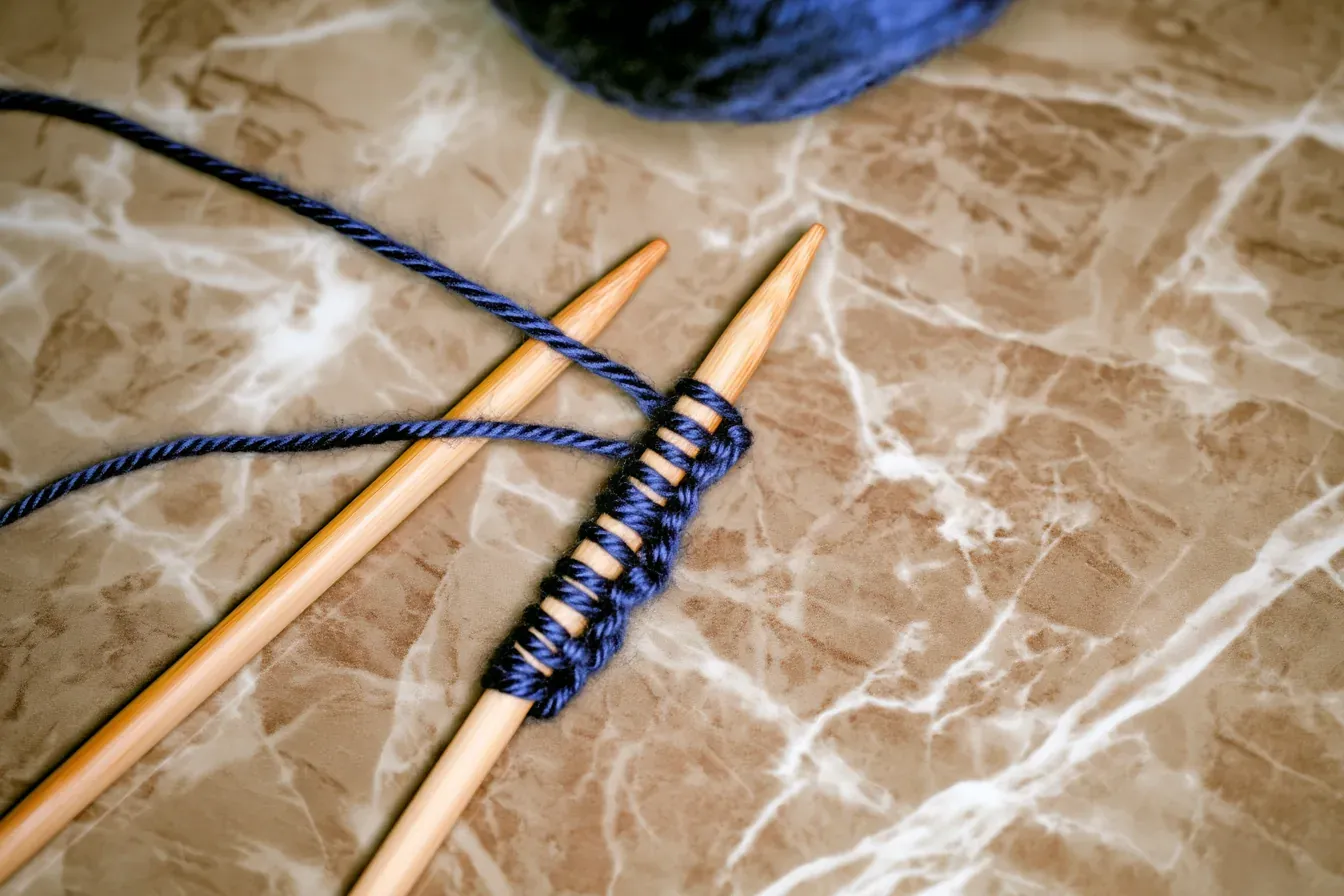
Casting on is the first step of any knitting project. It creates the starting row of stitches on your needle. The most popular all-purpose method is the long-tail cast on, which gives a neat, slightly stretchy edge. There are many cast-on methods for different needs, but a beginner only needs one to start. This guide teaches the long-tail cast on step by step, then explains when to use the others.
Before you start: the slip knot
Almost every cast on begins with a slip knot, which forms your first stitch:
- Make a loop with the yarn, leaving a tail.
- Reach through the loop and pull the working yarn through to make a second loop.
- Slide it onto your needle and pull both ends gently until the loop sits snugly on the needle. Do not pull it tight.
That slip knot counts as stitch number one.
The long-tail cast on (recommended for beginners)
The long-tail cast on uses both the tail and the working yarn at once. Leave a tail roughly three times the width of your finished cast-on edge, plus an extra 15 cm (6 in) for safety. A rough rule is about 2.5 cm (1 in) of tail per stitch for worsted yarn.
- Make a slip knot and place it on your right needle, with the tail towards you.
- Hold both strands in your left hand, the tail over your thumb and the working yarn over your index finger, and hold both ends against your palm. This is called the slingshot hold.
- Bring the needle up under the loop on your thumb.
- Take it over and under the strand on your index finger.
- Bring that strand back down through the thumb loop.
- Slip your thumb out and tighten gently. This makes one stitch.
- Repeat steps 3 to 6 until you have the number of stitches your pattern asks for.
Counting: the slip knot is your first stitch. If a pattern says "CO 20", you should have 20 loops on the needle including the slip knot.
Other cast-on methods, and when to use them
You do not need these yet. This is what each one is for, so you can choose later:
| Method | Best for |
|---|---|
| Long-tail | Everyday all-round method; neat and a little stretchy. → guide |
| Cable cast on | A firm, defined edge; easy to add stitches mid-row. → guide |
| Stretchy (e.g. German twisted) | Cuffs, sock tops, anything that needs to stretch. → guide |
| Provisional | When you will come back and knit from the cast-on edge later. → guide |
| Italian / tubular | A rounded, seamless-looking edge for 1×1 ribbing. → guide |
Frequently asked questions
What is the easiest cast on for beginners?
The long-tail cast on is the most recommended starting method. It is quick, gives a tidy, stretchy edge, and is used in the majority of patterns. Some people find the "knitted cast on" slightly simpler to grasp first, then switch to long-tail.
How long should the tail be for a long-tail cast on?
Leave about three times the width of your cast-on edge plus an extra 15 cm (6 in), or roughly 2.5 cm (1 in) of tail per stitch in worsted weight. If you run out, the estimate was short. Unravel and start again with a longer tail.
Does the slip knot count as a stitch?
Yes. The slip knot is your first cast-on stitch. Count it when matching the number your pattern requires.
Why does my cast on keep coming out too tight?
Beginners often pull each stitch tight against the needle. Keep the stitches loose enough to slide, or cast on over two needles held together, then slip one out.
What's the difference between casting on and casting off?
Casting on adds the first stitches at the start. Casting off (binding off, in US terms) secures and removes them at the end. See How to bind off.
Co-founder and editor of Knyt. Avid knitter!